


A Brief History of Paint
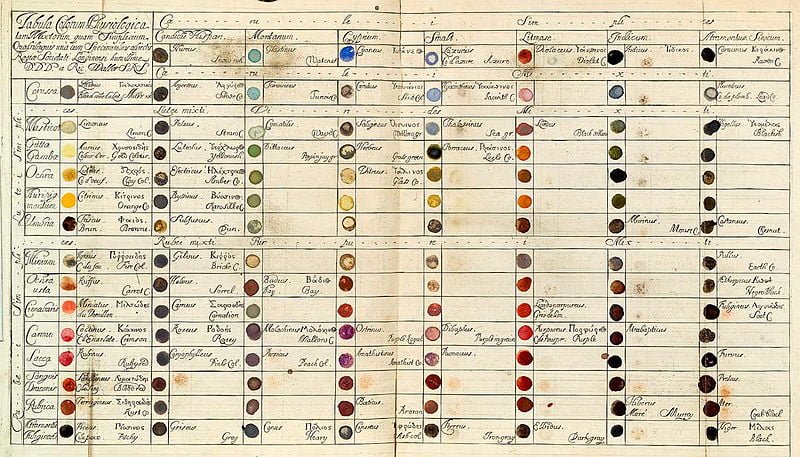
Richard Waller’s “Tabula Colorum Physiologica”, from “A Catalogue of Simple and Mixt Colours with a Specimen of Each Colour Prefixt Its Properties,” in Philosophical Transactions of the Royal Society of London, vol. 6 for the years 1686 and 1687 (1688) – Source.
The history of paints and pigments can be traced back to prehistoric times, with humans seeking ways to express themselves and their surroundings through color. The journey of paint and pigment development can be broadly divided into several stages:
- Prehistoric cave art (around 40,000 BCE): Early humans started using natural pigments like ochre (iron oxide), charcoal, and chalk to create simple cave paintings. They mixed these pigments with water or animal fat to create rudimentary paints, which were applied using fingers, sticks, or animal-hair brushes.
- Ancient civilizations (3000-1000 BCE): As civilizations advanced, so did the methods of producing and using pigments. Egyptians, for example, used minerals like malachite (green) and azurite (blue), as well as natural materials like soot and ground glass. They also discovered binders like gum arabic and egg whites, which helped pigments adhere to surfaces better.
- Classical era (500 BCE-500 CE): During this time, the Greeks and Romans further refined pigments, introducing lead white, red lead, and verdigris (green). They also used organic dyes extracted from plants and insects, such as madder and kermes. These societies developed sophisticated techniques for producing frescoes and encaustic paintings.
- Middle Ages (500-1400 CE): The development of pigments continued, with the introduction of ultramarine, made from lapis lazuli, and the widespread use of gold leaf in illuminated manuscripts. Artists relied on egg tempera, which combined pigments with egg yolk as a binder.
- Renaissance (1400-1600 CE): This period marked a significant advancement in the chemistry and technology of pigments. New pigments, like lead-tin yellow and smalt, were introduced, while old methods were refined. The use of oil as a binder, most notably by Jan van Eyck, revolutionized painting, allowing for richer colors, greater depth, and more flexibility.
- Industrial Revolution (18th-19th century): The Industrial Revolution brought about the mass production of pigments and paints, making them more accessible and affordable. Synthetic pigments were developed, like Prussian blue and cadmium yellow, while the introduction of the paint tube by John Goffe Rand in 1841 made it easier for artists to work en plein air.
- 20th century to present: The development of modern pigments continued, with the introduction of acrylics, alkyds, and a range of synthetic pigments. Today, artists have access to an unprecedented array of colors and mediums, as well as more environmentally friendly and lightfast options.



















0 Comments